
Sensitive
on the seagull of the Venice Biennale & ecological intelligence

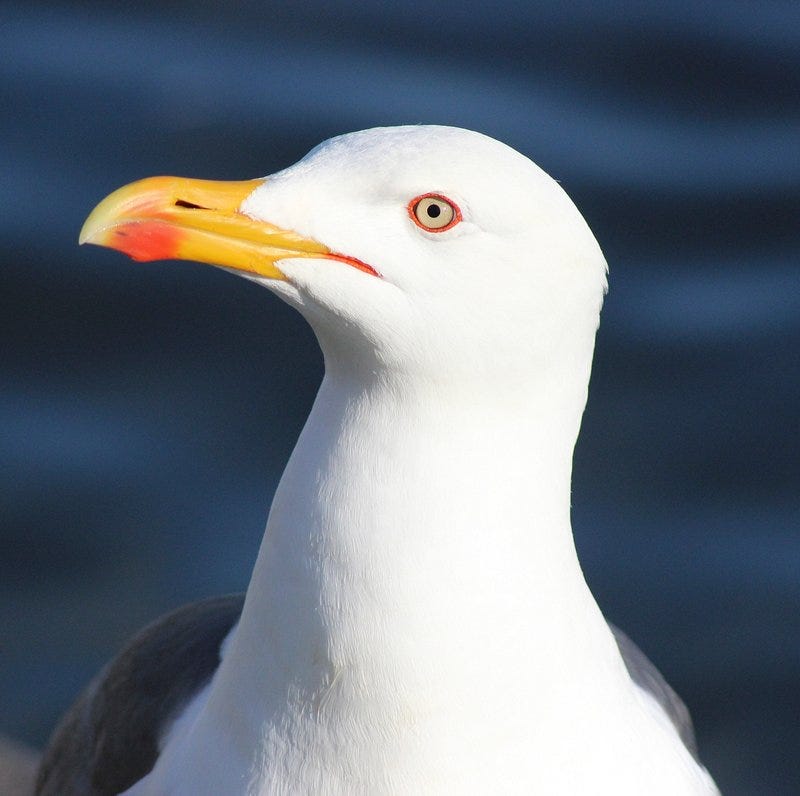
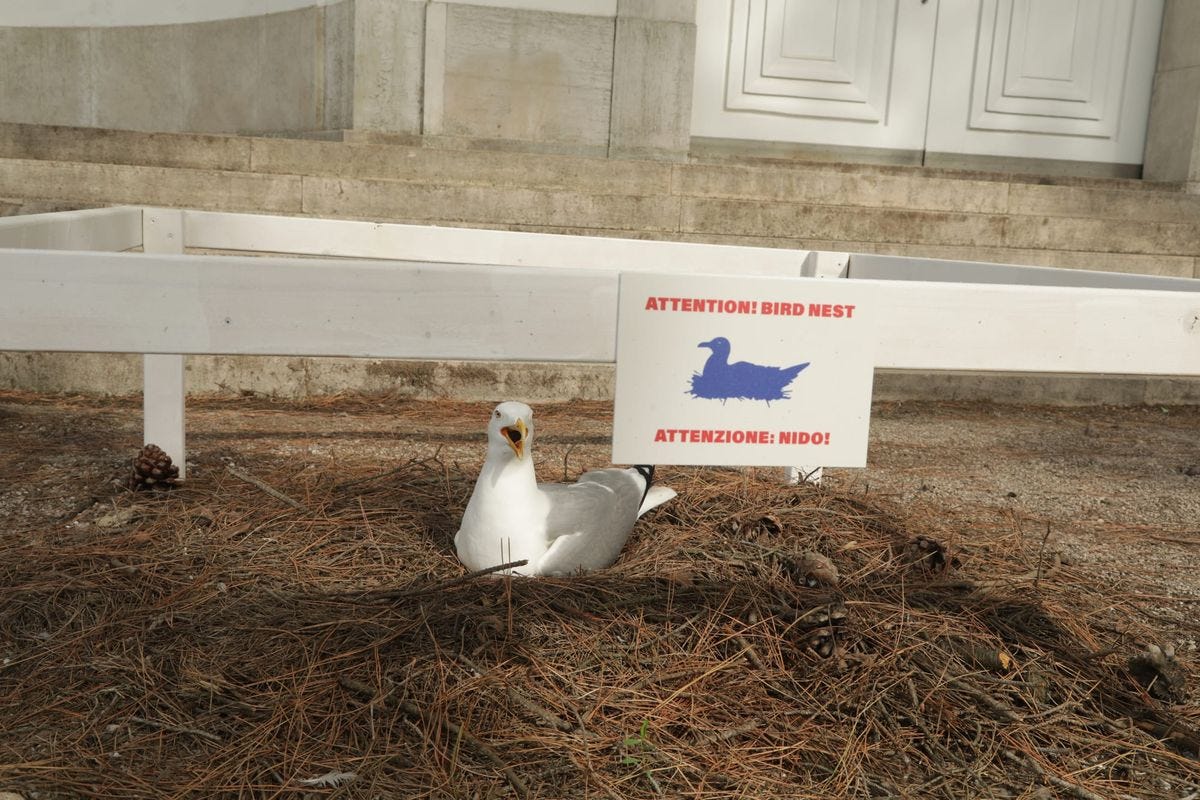
At this year’s Venice Biennale, a seagull (specifically a yellow-legged gull) nested on the grounds of the Danish Pavilion, remaining in place with her eggs despite the commotion of the international art world. Rather than remove the bird, organizers erected fencing around the nesting site, ceding the gull a measure of quiet and space amid the spectacle. In Hyperallergic, one woman described the gesture as “sensitive.” I found myself arrested by the word.
Sensitive is rarely meant as praise in American life. Sensitive people are difficult people, porous people, overreacting people. Sensitive children are sent into hallways to compose themselves. Sensitive women are unreliable narrators of their own experience. Sensitive artists are indulgent. Sensitive environmentalists are alarmists. Somewhere along the way, “sensitive” became shorthand for maladjusted to the hard bright machinery and violence of modern life.
And yet what is art, at its best, if not a cultivation of sensitivity? What is conservation? What is moral imagination?
I have spent much of my life trying to manage my own sensitivity into something more socially acceptable: more efficient, less porous, less likely to be wounded by the world. But sensitivity has also been the source of nearly everything meaningful in my life: writing, motherhood, friendship, attention to place, the long ache I feel toward other species and disappearing landscapes and people trying unsuccessfully to remain tender inside systems that reward hardness.
When I was a child, my elementary school teacher placed me out in the hallway after reading Stone Fox, the children’s book about a boy and his devoted sled dog trying to save the family farm. I was crying too hard to remain in class. Honestly, the adults of the 1980s and 90s repeatedly subjected us to the suffering and death of loyal dogs. Where the Red Fern Grows. Old Yeller. Benji. The emotional curriculum of American childhood seemed to insist that love would inevitably end in grief and that animals existed largely to tutor us in mortality. The death of a loyal dog - and I have survived many - is an easily plucked chord of the heart.
And yet I don’t think those stories were frivolous. I think they were trying to teach us something essential before the culture trained it out of us, before we were mortified of our own tenderness. These books were asking children to imagine nonhuman beings as worthy of devotion, grief, kinship, and moral regard. They were early and perhaps accidental rehearsals in resisting human exceptionalism, though I did not yet have language for that phrase.
To be sensitive is, in some ways, simply to remain interruptible by other forms of life.
The seagull enclosure at the Biennale is a modest gesture. No manifesto. No heroic intervention. Just fencing. A temporary recognition that another species might have claims on space, quiet, continuity, safety. The woman who called the act “sensitive” meant it as praise because sensitivity, in this case, described a willingness to perceive beyond the human ego and its appetites.
I increasingly believe this is the work before us now: not becoming less sensitive in order to survive modern life, but more appropriately sensitive. Sensitive to ecosystems. Sensitive to scale. Sensitive to extinction. Sensitive to labor. Sensitive to loneliness. Sensitive to the rights of other species to health, habitat, and continuity. Sensitive to the possibility that domination is not the only way to organize a civilization.
Sensitivity has costs, of course. It can make a person less armored inside institutions built around speed, certainty, extraction, and performance. It can make you feel perpetually out of step with a culture that rewards detachment. But I am beginning to wonder whether many of the people we call “too sensitive” are simply perceiving realities others have learned to ignore.
Perhaps sensitivity is not fragility after all but a form of ecological intelligence worthy of practice.
Well spoken and so true. A word to treasure. The image of you crying in class -- I know that feeling, too, but buried it deep.
And a teacher who couldn't be more proud of my shining star.
How delightful it is to have followed you and watched all your
many achievements.